
Written by Tigran Mkrtchyan · Reviewed and fact-checked by Narek Gevorgyan · Published July 24, 2026 · Last updated September 4, 2026 · Pricing and limits verified September 2026
Last year I sat in a launch-day war room at 2 a.m. We were shipping a big feature to thousands of users. Ten minutes in, the app froze. Balances would not load. Charts spun forever.
The cause was boring and brutal. Our public RPC endpoint had rate limited us. The node could not handle the traffic. We switched to a paid provider on the spot. The app came back within minutes.
I work in marketing, not engineering. But that night stuck with me. The provider serving your blockchain calls is not a small detail. Get it wrong and your launch becomes an outage.
So I did the homework. I researched the RPC node providers teams actually trust. Then I turned it into this guide.
Below are my five RPC node provider picks for 2026. I judged them on uptime, chains, free tiers, and price. Every one has a free tier, so test before you commit.
- An RPC node provider gives your app read and write access to a blockchain.
- Chainstack, GetBlock, dRPC, Ankr, and Tatum are our five picks for 2026.
- Most of these providers ship official MCP servers for AI agents.
- Every provider here has a free tier, so you can test first.
- An RPC handles node calls. A data API returns clean balances and prices.
What is an RPC node provider
An RPC node provider runs blockchain nodes so you do not have to. RPC stands for remote procedure call. Your app sends a request to a node and gets data back.
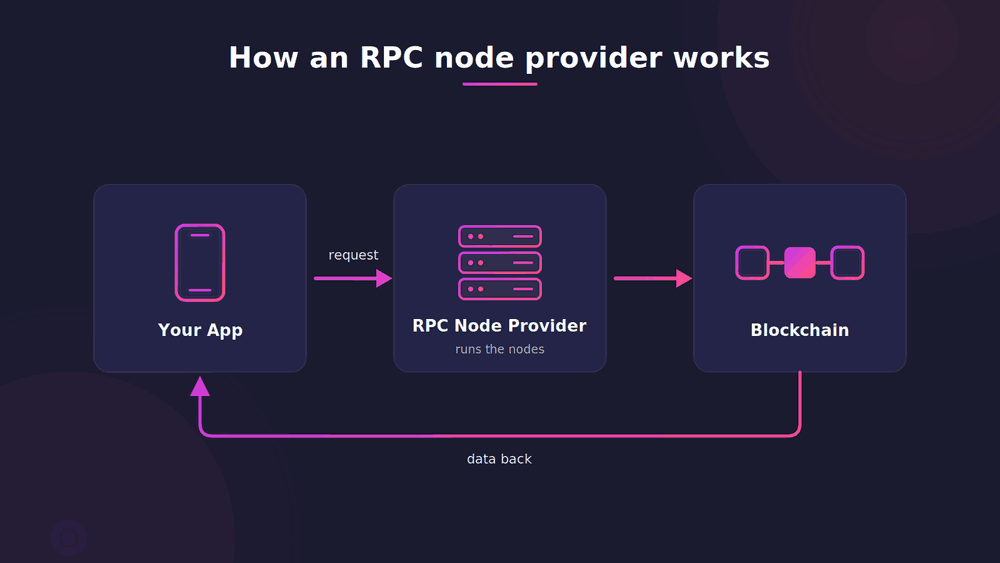
That includes balances, blocks, transactions, and contract reads. You can also broadcast signed transactions to the network. Running your own node is possible but slow and expensive.
A provider handles uptime, scaling, and archive history for you.
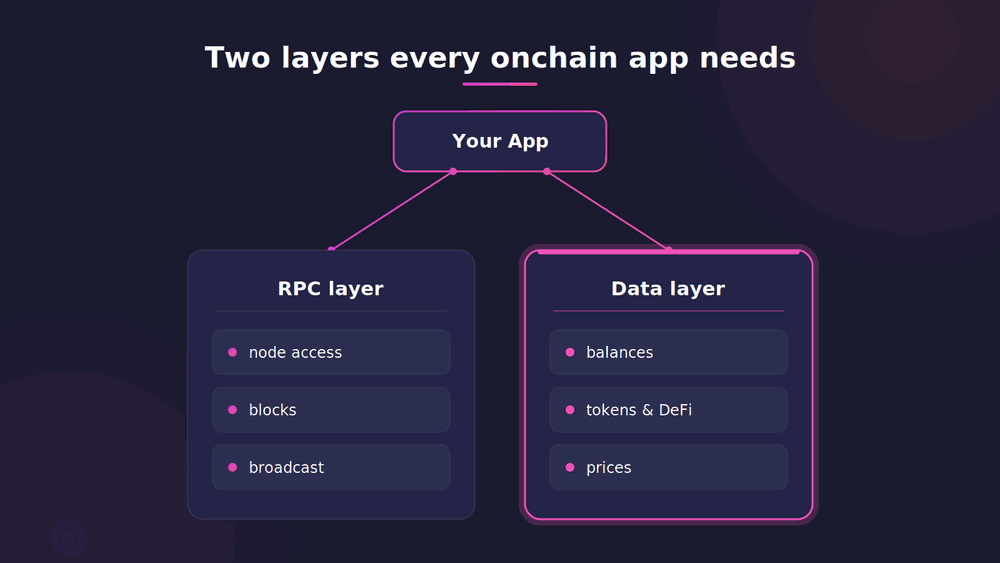
Here is the split that trips people up. An RPC gives you raw node access. It does not clean or enrich the data. A data API does that part. It returns ready balances, token metadata, and prices. Most production apps use both.
These are the five things we weighed for each provider:
- Reliability and uptime. Does it hold up under real load, not on a quiet day?
- Latency and location. How fast does it respond from your users’ region?
- Chain coverage. Does it support the networks you actually ship on?
- Free tier and pricing. Can you test for free, then scale on clear terms?
- Node types. Are archive nodes, WebSockets, and dedicated nodes available?
One more note on AI. Most serious providers now ship an MCP server. So MCP is becoming a baseline, not a differentiator. The real difference is the data underneath.
The data layer to pair with your RPC
Here is the part builders learn the hard way. An RPC gives you raw node access. It does not give you a clean portfolio view. You still build balances, token metadata, prices, and DeFi positions yourself. That is weeks of work per chain.
CoinStats API does that layer for you. One wallet address returns balances, tokens, DeFi, and prices. It covers 120+ blockchains through one schema. So it pairs with any RPC provider below.
CoinStats API is read only. It does not replace an RPC. Think of it as the data layer on top.
For the read side, see free data APIs to pair with them.
CoinStats API is an all-in-one crypto data layer. It bundles wallet balances, DeFi, market data, and token risk. One address returns the whole picture in one call.
- Wallet balances and transactions across 120+ chains.
- DeFi positions detected across 10,000+ protocols.
- Live prices for 100,000+ coins from 200+ exchanges.
- Token Risks endpoint and an official MCP server.
Note: CoinStats API is read only. Pair it with an RPC for node calls and broadcasting.
One practical example. You call your RPC for node access and transaction broadcasting. You call CoinStats Crypto API for the enriched wallet view. Your users see balances, DeFi, and prices in one response. For the wider landscape, see our best crypto API guide. Building trading tools or AI agents? See the best crypto APIs for trading and AI agents.
Developers were stitching five services together to read one wallet. That is backwards. One address should return the whole picture. Balances, DeFi, prices, portfolio, and token security, in one call. The teams winning today ship fast on clean data.
Narek Gevorgyan, founder and CEO, CoinStats
The 5 best RPC node providers at a glance
| Provider | Best for | Chains | Free tier | Entry price |
|---|---|---|---|---|
| Chainstack | Managed enterprise nodes | 70+ | Yes, 3M requests/mo | Growth from $49/mo |
| GetBlock | Broad multi-chain node access | 100+ | Yes, daily CU limit | Pro from $399/mo billed yearly |
| dRPC | Decentralized redundancy | 120+ | Yes, public nodes | Usage based, ~$6/1M |
| Ankr | Budget multi-chain | 80+ | Yes, high limits | Pay as you go from $10 |
| Tatum | RPC plus data and MCP | 100+ | Yes, 100k lifetime credits | Dedicated from $99/mo |
Pricing and limits verified September 2026. Providers change terms often, so confirm before you build.
Chainstack

Chainstack powers global blockchain apps for fintech, DeFi, wallets, custodians, and analytics. It delivers reliable, predictable RPC across 70+ protocols.
- Managed and self-managed nodes across 70+ protocols.
- Archive data, debug, and trace on paid plans.
- Global infrastructure with regional endpoints for low latency.
- Official MCP server for AI agents.
What to verify: free tier covers light usage only. Confirm archive and region options for your chain.
GetBlock
GetBlock runs shared and dedicated nodes across many chains. It offers JSON-RPC, WebSocket, and gRPC access. It suits teams that want one vendor for many networks.
- Shared and dedicated nodes on 100+ chains.
- JSON-RPC, WebSocket, and gRPC interfaces.
- Archive data on most supported chains.
- Dedicated single-chain nodes for steady workloads.
What to verify: free and entry limits differ across GetBlock pages. Its MCP server is new and lightweight.
dRPC
dRPC routes your calls across many independent node operators. That spreads risk and avoids a single point of failure. It also ships an official MCP layer for AI agents.
- Decentralized routing across 120+ chains.
- Generous free tier on public nodes.
- Debug and trace API on paid plans.
- Official Agent Skills for MCP and AI.
What to verify: usage based billing is harder to budget. Confirm WebSocket support for your chain.
Ankr

Ankr offers globally distributed RPC endpoints at low cost. It adds token and NFT query APIs on top. It fits budget projects that still want broad coverage.
- RPC endpoints across 80+ blockchains.
- Free tier with high request limits.
- Pay as you go, no fixed monthly fee.
- Extra token data query APIs.
What to verify: there is no flat monthly plan. Check WebSocket and archive credit costs per chain.
Tatum
Tatum bundles RPC nodes with data APIs and notifications. One key covers node access and enriched data. It also ships an official MCP server for AI agents.
- RPC nodes across 100+ chains.
- Data API, webhooks, and wallet tooling.
- Official MCP server for AI agents.
- Dedicated API keys for guaranteed throughput.
What to verify: chain-count claims vary across pages. Plan prices sit behind a dashboard slider.
Top picks by category
Shared and dedicated nodes on many chains.
Pick this for one vendor across networks.
Routes calls across many independent operators.
Pick this for redundancy and fewer outages.
Low cost with a generous free tier.
Pick this for cheap multi-chain scaling.
Global, dedicated, and self-hosted nodes.
Pick this for reliability at scale.
Node access and enriched data in one key.
Pick this to cut vendor count early.
Clean balances, DeFi, and prices on top.
Pair this with any RPC above.
Comparison by use case
Multi-chain dApps
Top pick: GetBlock. Broad coverage under one vendor.
Alternatives: dRPC, Ankr.
DeFi and trading bots
Top pick: dRPC. Decentralized routing cuts single-node risk.
Alternatives: GetBlock, Ankr.
Budget and side projects
Top pick: Ankr. Free limits are high and scaling is cheap.
Alternatives: dRPC, Tatum.
Enterprise and compliance
Top pick: Chainstack. Managed nodes with archive and strong SLAs.
Alternatives: GetBlock.
RPC and data together
Top pick: Tatum. One key covers nodes and data.
Or pair any RPC with CoinStats API.
AI agents and MCP
Top pick: dRPC or Tatum. Chainstack and GetBlock also ship MCP servers.
Add CoinStats API MCP for wallet data.
How to choose your RPC provider
Start with your use case, not the logo. Match the provider to what you ship. Then test the free tier with real calls.
Watch three things under load. Check uptime on a busy day, not a quiet one. Check latency from your users’ region. Check the rate limits on your plan.
Read the actual response, not the homepage promise. Confirm archive and WebSocket support if you need them. Then scale only when the free tier runs out.
One last tip. An RPC gives you node access. It does not give you clean portfolio data. Pair it with a data API when your users need balances and prices. Need exchange and market feeds? See the best aggregated crypto exchange APIs for market data.
One more 2026 shift: Sim by Dune shut down in August. RPC nodes alone do not replace it. Compare Dune Sim alternatives for the data layer.
Community and further reading
Representative of recurring r/ethdev threads on choosing a reliable RPC provider.
GitHub · Awesome RPC node providers. A community list of public endpoints and node providers. Medium · What is behind your RPC, explained. Node types, clients, and archive access.Need indexed Solana data instead of raw RPC? See the best Solana APIs.
Frequently asked questions about RPC node providers
What is an RPC node?
What is an RPC node provider?
Do I need to run my own RPC node?
What is the difference between an RPC and a data API?
What is the difference between a public and a private RPC endpoint?
What is an archive node?
What is the best RPC for Solana?
What is the best RPC for Ethereum?
Are there free RPC node providers?
How much does an RPC provider cost?
Which RPC providers support AI agents and MCP?
What is the best RPC node provider?
How do I choose an RPC node provider?
Tigran is the Head of Digital Marketing at CoinStats, working across crypto and consumer apps. His writing covers first-hand crypto experience and marketing case studies from that work. He has taken the stage at industry-leading conferences like MAU Vegas, Business of Apps Berlin, and App Promotion Summit London.
More from Tigran on the CoinStats blog · LinkedIn · X

You can get bonuses upto $100 FREE BONUS when you:
💰 Install these recommended apps:
💲 SocialGood - 100% Crypto Back on Everyday Shopping
💲 xPortal - The DeFi For The Next Billion
💲 CryptoTab Browser - Lightweight, fast, and ready to mine!
💰 Register on these recommended exchanges:
🟡 Binance🟡 Bitfinex🟡 Bitmart🟡 Bittrex🟡 Bitget
🟡 CoinEx🟡 Crypto.com🟡 Gate.io🟡 Huobi🟡 Kucoin.












Comments