
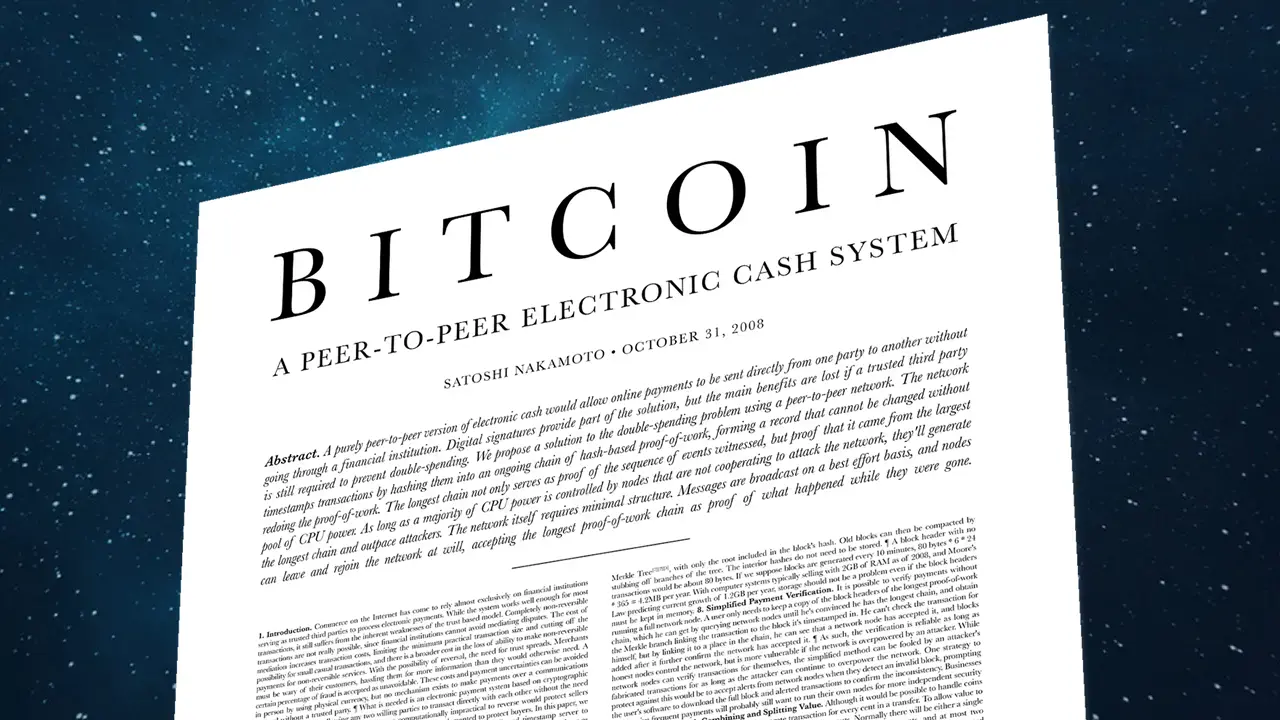
Bitcoin’s white paper turns 18 on October 31, 2026, marking nearly two decades since Satoshi Nakamoto introduced a proposal for electronic payments without a central intermediary. The anniversary also brings renewed attention to a fundamental question: how will the network fund its security as newly issued bitcoin becomes increasingly scarce?
Nakamoto’s original announcement, published on October 31, 2008, outlined a way to prevent double-spending through a peer-to-peer network. Its lasting contribution was a method for participants to agree on transaction history without putting one institution in charge.
Bitcoin’s Security Depends On Economic Incentives
The Bitcoin white paper connected network security with financial incentives. Miners would expend computing resources to produce blocks, receiving newly created coins and transaction fees in return.
Proof-of-work makes rewriting confirmed transactions costly because an attacker must redo the relevant computational work and catch up with the honest network. The incentive model encourages participants to direct their resources toward maintaining that shared history.
Satoshi also anticipated a future in which transaction fees would replace newly issued coins as the source of mining compensation. That transition was part of the original proposal, although the paper did not establish how much fee demand would ultimately develop.
Cambridge Research Shows Fees Remain A Small Revenue Source
Recent research from the Cambridge Centre for Alternative Finance highlights the distance between that long-term model and miners’ current revenue mix.
Transaction fees accounted for 0.67% of total miner revenue during the 90 days ending October 4, 2026, according to the analysis. Researchers also found that fees stayed below 5% of miner revenue for most of Bitcoin’s operational history.
Periods of heavy transaction demand can temporarily change that balance. Cambridge pointed to the April 2024 launch of the Runes protocol as an example of congestion generating a substantial fee spike.
However, short bursts of activity do not necessarily provide the predictable income miners need to support ongoing operations. The findings underline Bitcoin’s continuing reliance on block subsidies without establishing that a security crisis is imminent.
Halvings Keep Changing The Mining Equation
Bitcoin’s protocol documentation explains that the block subsidy halves every 210,000 blocks. This reduces the quantity of newly created bitcoin miners can receive, while transaction fees provide a separate source of compensation.
The economic implication is that miners must adapt as issuance declines. A higher bitcoin price could offset a smaller subsidy in dollar terms, while changes in electricity costs and equipment efficiency could affect profitability. None of those outcomes is guaranteed.
Difficulty adjustments help block production respond to changes in the network’s computing power. They do not generate additional mining income. Maintaining the pace of block production and sustaining the economic resources committed to security are therefore related but distinct issues.
Bitcoin’s Use Case Debate Takes On Added Importance
The discussion also connects with Bitcoin’s role as a payment network.
As Bitcoinist previously reported, Jack Dorsey argued that Bitcoin needs everyday payment utility beyond its appeal as a store of value. His April 2025 comments focused on the cryptocurrency’s long-term relevance, rather than a specific prediction about miner earnings.
For security funding, the key question is how usage translates into sustained demand for block space and fees paid to miners. Cambridge’s research suggests that this deserves attention alongside price performance when assessing the network’s long-term economics.
Eighteen years after its publication, the white paper still provides the starting point for that discussion. Satoshi outlined how fee-funded security could work. Whether transaction demand will support that model consistently remains an open question.

You can get bonuses upto $100 FREE BONUS when you:
💰 Install these recommended apps:
💲 SocialGood - 100% Crypto Back on Everyday Shopping
💲 xPortal - The DeFi For The Next Billion
💲 CryptoTab Browser - Lightweight, fast, and ready to mine!
💰 Register on these recommended exchanges:
🟡 Binance🟡 Bitfinex🟡 Bitmart🟡 Bittrex🟡 Bitget
🟡 CoinEx🟡 Crypto.com🟡 Gate.io🟡 Huobi🟡 Kucoin.










Comments